

Separate what & where tokens
Acoustic and spatial conditions retain dedicated representations and interact within the causal transformer.
1Brown University2MIT3Yale University4The University of Hong Kong
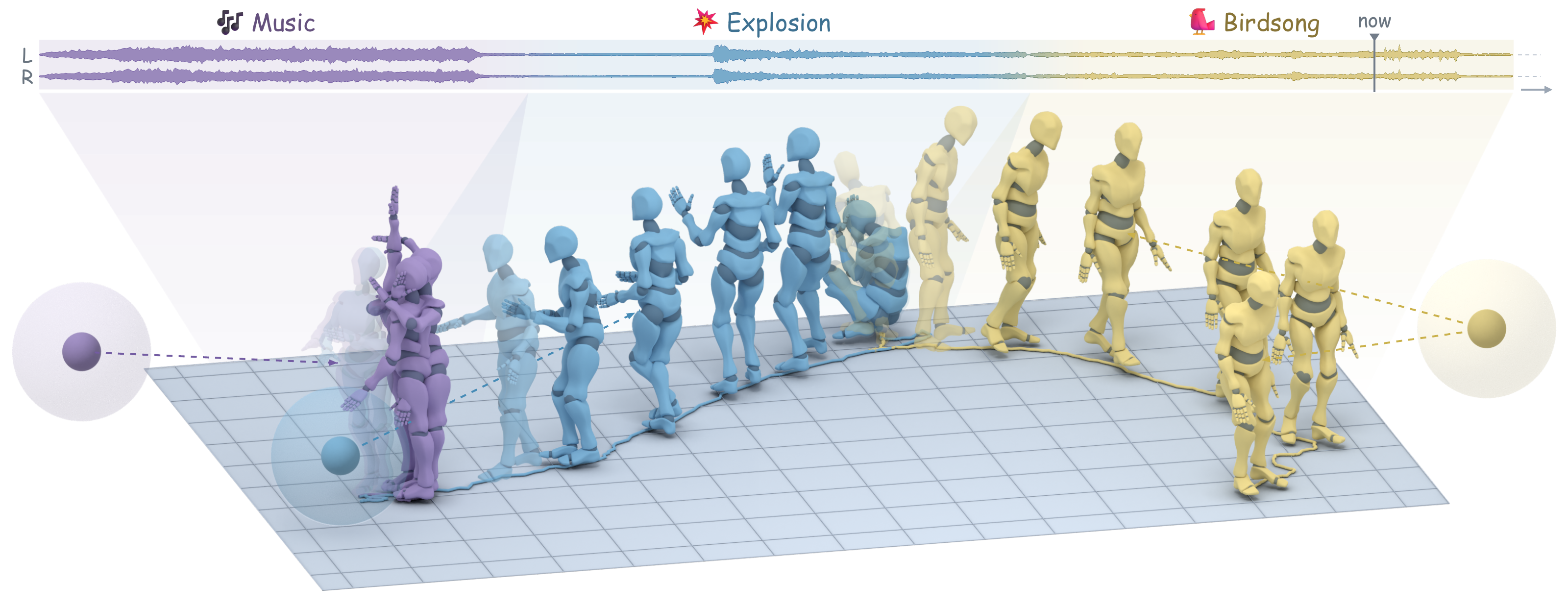
Modeling human reactions to spatial audio requires understanding both what is heard and where it comes from. Prior work generates motion offline from complete acoustic and spatial input sequences. Humans, however, react to sounds without knowing what they will hear next. We present Sonic-AMG, the first autoregressive framework for generating human motion from streaming spatial audio. The model encodes acoustic content and body-relative source geometry as separate tokens. A causal transformer with a flow head generates continuous motion latents, which a causal decoder reconstructs into motion segments. Teacher-forced training uses motion histories and body-relative source locations derived from recorded motion, whereas streaming inference relies on generated motion for both. We introduce rehearsal training, which combines full-sequence teacher-forced supervision with supervised prediction on histories constructed through short autoregressive self-rollouts, improving robustness to accumulated prediction errors. To keep spatial conditioning consistent with generated motion, we propose spatial feedback, which recomputes body-relative source locations from generated root poses during both rehearsal training and inference. On SAM, Sonic-AMG achieves state-of-the-art FID and R-precision. It further supports real-time online generation of coherent reactions across sound events and source locations. Our code and model will be released upon acceptance.
What is heard. Where it comes from.
A causal model connects both to the next movement.
Acoustic content and body-relative source geometry are encoded as separate tokens. Both condition the next motion prediction.
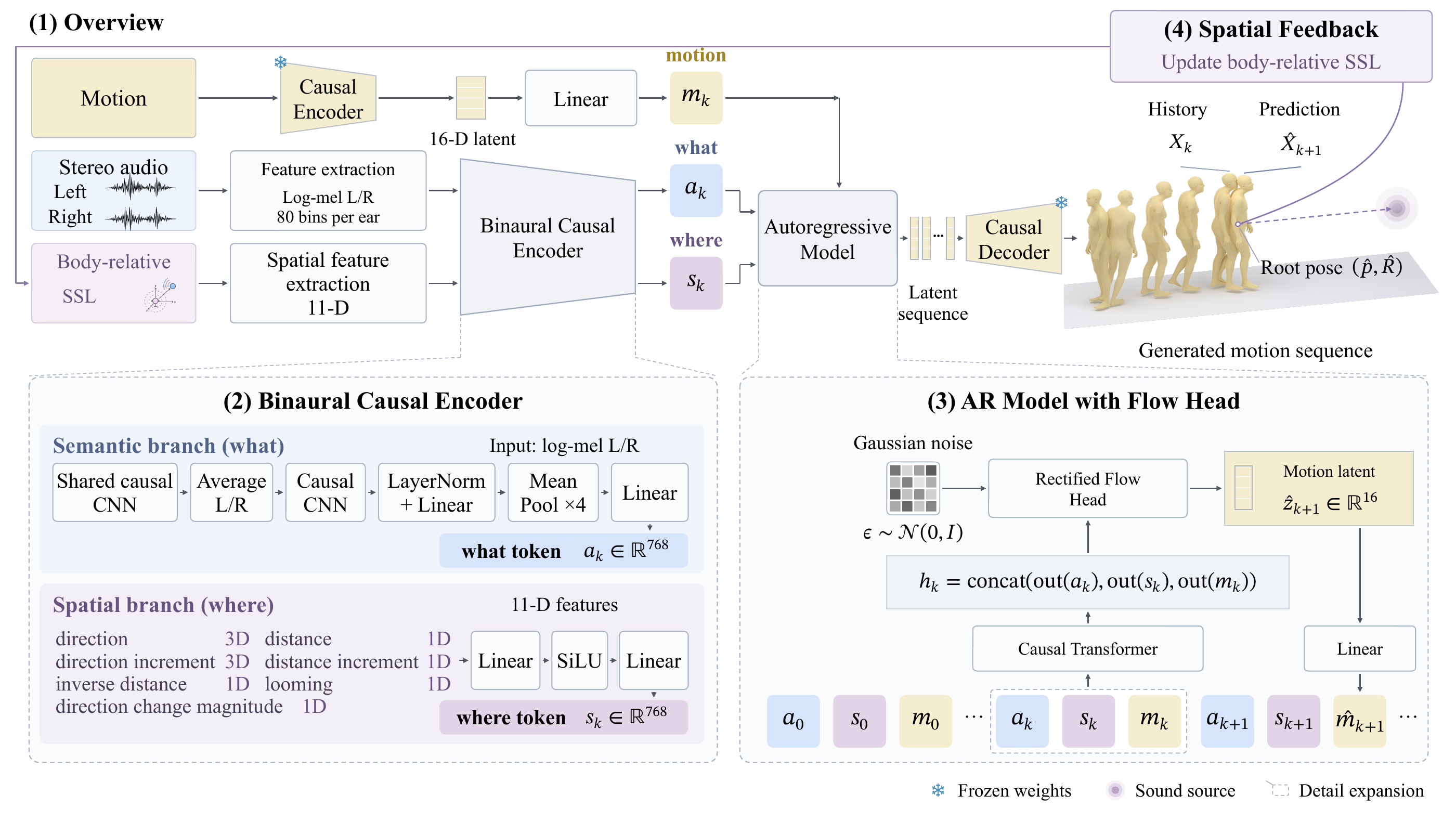
Acoustic and spatial conditions retain dedicated representations and interact within the causal transformer.
Teacher-forced supervision is combined with prediction from short autoregressive self-rollouts.
Source coordinates are updated from the generated root pose, keeping spatial conditions consistent with the moving body.
Continuous reactions.
From spatial audio to physical motion.
GT and Online spatial conditioning.
Improved distributional fidelity, with support for causal generation.
FID · lower is better
Zoomed axis · 95% confidence intervals
| Method | Causal | Eval. SSL | FID ↓ | R@1 ↑ | R@2 ↑ | R@3 ↑ | Diversity |
|---|---|---|---|---|---|---|---|
| GT motion† | — | — | 0.001 | 1.000±0.000 | 1.000±0.000 | 1.000±0.000 | 23.616±0.188 |
| EDGE† | No | GT | 13.993 | 0.886±0.005 | 0.960±0.003 | 0.977±0.002 | 23.099±0.196 |
| POPDG† | No | GT | 20.967 | 0.762±0.006 | 0.886±0.005 | 0.934±0.003 | 22.536±0.170 |
| LODGE† | No | GT | 102.289 | 0.444±0.006 | 0.594±0.005 | 0.679±0.004 | 21.101±0.141 |
| Bailando† | No | GT | 168.396 | 0.077±0.003 | 0.134±0.003 | 0.182±0.004 | 17.347±0.247 |
| MOSPA | No | GT | 8.242 | 0.942±0.004 | 0.984±0.002 | 0.994±0.001 | 23.412±0.169 |
| Sonic-AMG (Ours) | Yes | GT | 6.505 | 0.957±0.004 | 0.991±0.002 | 0.998±0.001 | 23.241±0.158 |
| Sonic-AMG (Ours) | Yes | Online | 8.066 | 0.943±0.004 | 0.984±0.002 | 0.994±0.001 | 23.194±0.149 |
GT uses spatial cues from recorded motion; Online updates them from generated motion. R-precision and Diversity report mean ± 95% confidence intervals. Diversity is compared with real motion. † Results reported by Xu et al. (2025).
Sonic-AMG starts reacting before the recording ends and keeps generating for its full duration. MOSPA waits for the complete input and produces a fixed 8-second motion.
First-frame latency on NVIDIA RTX A6000.
Approximately 59× lower with Sonic-AMG.
Unable to load this video. Open video directly.
Music, an explosion, then birdsong. One continuous motion stream follows changing sounds and source locations—even though training uses individual audio–motion clips.
Unable to load this video. Open video directly.
Unable to load this video. Open video directly.
Covering the ears, swatting at insects, and gesturing to speech: Sonic-AMG generates varied whole-body reactions to everyday sounds.
Lift a knee and gesture
Unable to load this video. Open video directly.
Bend forward
Unable to load this video. Open video directly.
Cover ears
Unable to load this video. Open video directly.
Swatting gestures
Unable to load this video. Open video directly.
Gesture with both hands
Unable to load this video. Open video directly.
Step sideways and turn
Unable to load this video. Open video directly.
Sound-driven human motions transfer to a Unitree G1 in physical simulation, turning generated reactions into robot motion under gravity and ground contact.
Lift a knee and gesture
Unable to load this video. Open video directly.
Unable to load this video. Open video directly.
Bend forward
Unable to load this video. Open video directly.
Unable to load this video. Open video directly.
Cover ears
Unable to load this video. Open video directly.
Unable to load this video. Open video directly.
Swatting gestures
Unable to load this video. Open video directly.
Unable to load this video. Open video directly.
Turn and return
Unable to load this video. Open video directly.
Unable to load this video. Open video directly.
Raise an arm
Unable to load this video. Open video directly.
Unable to load this video. Open video directly.
Hand toward mouth
Unable to load this video. Open video directly.
Unable to load this video. Open video directly.
Draw arms inward
Unable to load this video. Open video directly.
Unable to load this video. Open video directly.
Gesture with both hands
Unable to load this video. Open video directly.
Unable to load this video. Open video directly.
Step sideways and turn
Unable to load this video. Open video directly.
Unable to load this video. Open video directly.
Retargeted with GMR; tracked in MuJoCo by the pretrained GEAR-SONIC controller. These are offline physical rollouts.